
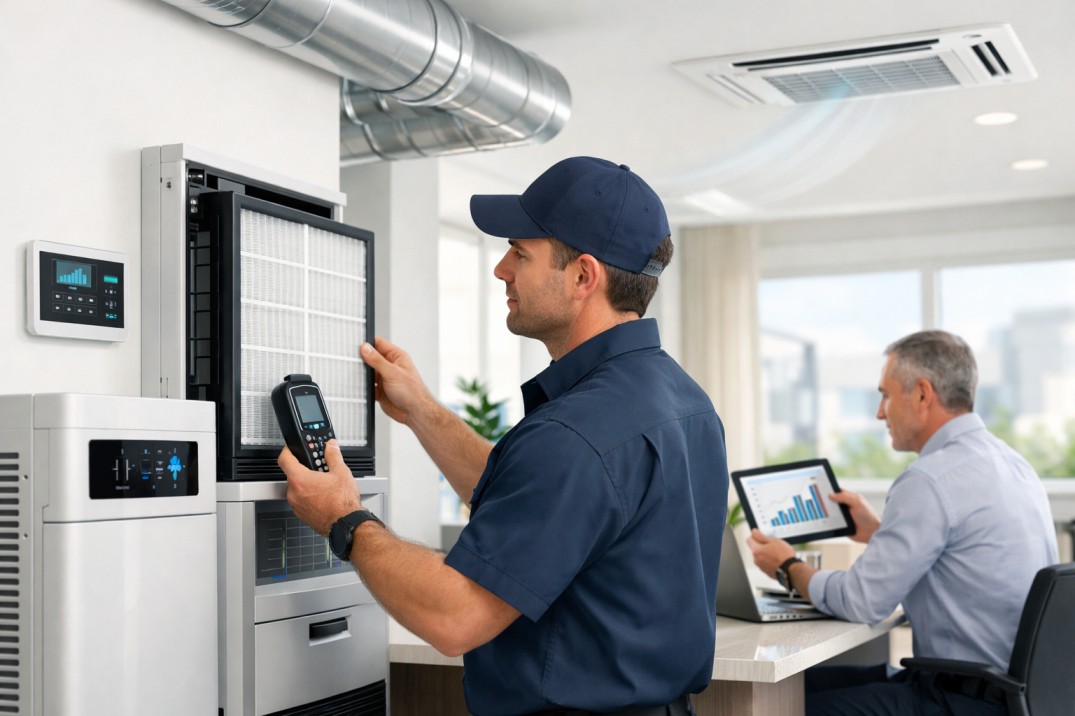
Buyers are no longer evaluating HVAC companies only by trucks, headcount, and last year’s revenue. In today’s market, IAQ services’ HVAC business value has become a defining lens for what “premium” looks like—because efficiency and indoor air quality (IAQ) offerings create measurable outcomes buyers care about: stronger margins, stickier customers, and more predictable cash flow.
BlueExit For owners preparing for a transition and for acquirers building regional platforms, the trend is clear. The HVAC companies earning the most attention are those that can document efficient operations, deliver high-trust IAQ solutions, and convert service relationships into recurring revenue. If you want to see how these drivers translate into pricing, start with blueexit and how buyers assess quality in HVAC acquisitions.
The buyer mindset has shifted from “volume” to “quality of earnings.”
In prior cycles, growth was often judged by top-line momentum—more installs, more calls, more technicians. That still matters, but modern acquirers focus on the quality of earnings, and they increasingly view IAQ and efficiency as direct inputs into that quality.
Efficient services signal disciplined systems, standardized processes, and a tech-enabled workforce. IAQ services signal trust, consultative selling, and a customer relationship that goes beyond emergencies. Together, they support pricing power and recurring demand, which reduces volatility—exactly what buyers underwrite when they choose a higher multiple.
Why efficiency services are becoming a valuation multiplier
Efficiency isn’t just about equipment ratings; it’s about the company’s ability to deliver outcomes consistently. Buyers love efficiency-led businesses because they tend to be operationally mature and easy to scale.
Better gross margin structure often comes from improved job scoping, fewer callbacks, and cleaner installation standards. Companies that sell efficiency upgrades—air sealing, duct improvements, smart controls, zoning, and high-efficiency system replacements—typically develop stronger estimating discipline and clearer processes. That discipline shows up in normalized earnings, which directly supports IAQ services’ HVAC business value in a buyer’s model.
Higher close rates are another advantage. When a company can explain comfort problems with diagnostics and offer an efficiency roadmap, the sale becomes less price-driven and more outcome-driven. Buyers interpret that as durable demand and defensible market positioning.
Why IAQ services are becoming a premium revenue category
Indoor air quality used to be “nice to have.” Now it’s a strategic layer that changes customer behavior and revenue quality. When IAQ is sold the right way—diagnostic first, solution second—it builds long-term trust and creates ongoing service touchpoints.
IAQ drives add-on revenue without relying on weather spikes. Filtration, ventilation, humidity control, UV solutions, and monitoring can complement replacement work and increase average ticket value. More importantly, IAQ creates a reason to stay connected to the customer after the install, which improves retention and supports maintenance plan conversions.
IAQ increases customer stickiness. A customer who buys an IAQ solution is buying peace of mind, not just equipment. That relationship is less likely to be disrupted by a competitor’s discount because the decision is anchored in health, comfort, and measurable improvements. From a buyer’s view, that reduces churn risk and stabilizes cash flow—two big drivers behind IAQ services’ HVAC business value.
The hidden reason buyers favor IAQ and efficiency: recurring revenue quality
Recurring revenue isn’t only about maintenance agreements—it’s about predictable, repeatable customer engagement. Efficiency upgrades and IAQ solutions naturally support recurring models because they require verification, filter changes, seasonal checks, and ongoing optimization.
When buyers see strong recurring programs, they see a business that can withstand shocks: slower construction cycles, seasonal softness, or competitive pressure. That’s why many acquirers now ask early questions like: What percentage of customers are on plans? How often do you touch the customer annually? What portion of revenue comes from renewals and replacements versus one-off calls?
BlueExitThese are the same questions that show up in a proper HVAC business valuation process, where earnings quality, customer retention, and margin durability matter as much as size.
What buyers look for when IAQ becomes part of the story
It’s not enough to “offer IAQ.” Buyers want evidence that IAQ is built into the company’s operating system and sales process. They look for clarity in a few areas.
Documented attach rates. What percentage of system replacements include IAQ add-ons? Is it consistent across locations and salespeople?
Standardized diagnostics. Is IAQ sold through a repeatable assessment process, or is it random and personality-driven?
Training and compliance. Are technicians trained to diagnose airflow, filtration needs, humidity issues, and ventilation requirements without overselling?
Clean reporting. Can the company show margins, close rates, and customer retention tied to IAQ and efficiency categories?
When these elements are present, the IAQ services’ the’ HVAC business value becomes tangible rather than theoretical.
How owners can position the business to capture this buyer demand
Owners don’t need to reinvent the company overnight, but they do need to align operations with what buyers now pay for. The highest-impact move is to create a credible “value narrative” supported by metrics and process.
If you’re building toward a future transaction, it helps to map these initiatives into a broader readiness plan like strategic exit planning—so the operational improvements you make are reflected in earnings quality, documentation, and buyer confidence.
A trusted baseline for IAQ fundamentals
For a straightforward overview of indoor air quality concepts and why they matter, the U.S. Environmental Protection Agency provides a helpful starting point: EPA indoor air quality (IAQ).
FAQ
What does “IAQ services HVAC business value” mean to buyers?
It refers to how indoor air quality services improve valuation drivers like margins, recurring revenue, customer retention, and lower earnings volatility.
Why are buyers paying more attention to efficiency services now?
Efficiency signals operational maturity, fewer callbacks, stronger estimating discipline, and higher close rates—factors that improve the quality of earnings and scalability.
Do IAQ services really increase recurring revenue?
Yes, when IAQ is sold through diagnostics and ongoing care, it supports maintenance plan growth, repeat touchpoints, and add-on upgrades over time.
What proof should an HVAC owner prepare before marketing the company?
Buyers typically want attach rates, margin by category, plan penetration, retention indicators, training standards, and clean financial reporting that supports the IAQ and efficiency story.
Call to action
Buyer priorities are evolving fast, and companies that can prove efficiency, discipline, and IAQ-driven customer relationships are increasingly positioned as premium acquisitions. If you want to understand how these drivers translate into pricing and deal structure, explore HVAC business broker services and build a clear path to a stronger outcome.