
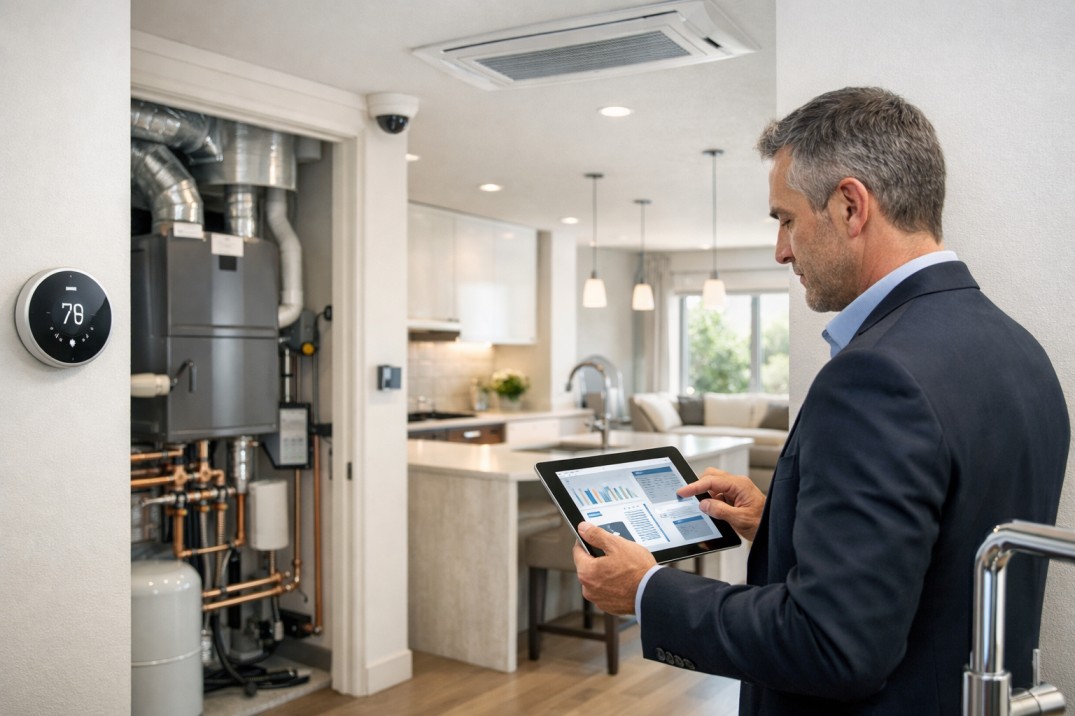
“Smart home” seemed like a high-end feature a few years ago. Now it’s just… normal. Homeowners expect app control, smart thermostats, indoor air quality monitors, and alerts that tell them when something’s off before comfort becomes an emergency.
If you’re planning a smart home HVAC business sale, this shift matters more than most owners realize. Buyers aren’t only purchasing trucks, technicians, and a book of customers anymore. They’re buying your ability to serve modern homes—and to do it with systems that scale without you being the person who solves every Wi-Fi problem.
If you’re still early in planning, start with the big picture at blueExit so your exit timeline, prep work, and positioning all move in the same direction.
Why smart home demand is changing what buyers pay for
Buyers don’t pay a premium because your website mentions “smart thermostats.” They pay more when smart-home work shows up in the numbers and in the way the company runs day to day.
Here’s what smart home demand often signals to a buyer:
- You’re aligned with where the market is going. Owners who keep up with connected systems usually keep up with other operational improvements too.
- Your revenue can get stickier. Connected devices can lead to proactive maintenance, membership plans, and recurring touchpoints.
- Your processes are more “buttoned up.” Smart-home installs tend to require checklists, documentation, and consistent handoffs, which makes the business look easier to operate and scale.
In a smart home HVAC business sale, these details can reduce perceived risk—and that’s what often supports stronger offers and cleaner terms.
What buyers will ask during diligence (and how to be ready)
Smart home capability adds a few extra diligence questions that didn’t exist in the same way before. Buyers will want clarity in three areas.
1) Can your team deliver this work without drama?
Smart-home installs are simple when they’re done the same way every time. They become expensive when every job turns into a custom troubleshooting session.
Buyers will look for repeatability:
- Do you have a standard install process?
- Is app onboarding part of the handoff?
- Do you test connectivity before you leave?
- Can more than one tech handle the job confidently?
If your connected-systems knowledge lives in one person’s head, buyers may view that as key-person risk.
2) Does smart-home work improve margins—or create callbacks?
Connected devices can raise average ticket size, especially when paired with zoning, IAQ, or whole-home upgrades. But if your team is getting buried in post-install support calls, it can quietly eat margin.
Buyers will want to know:
- What support issues happen most often?
- How frequently do callbacks occur?
- What’s covered vs. what becomes billable support?
3) Can the financials prove the story?
A buyer can’t pay for “potential” unless you can show it. If smart-home revenue is scattered across invoices with no clean category or tag, it’s harder for a buyer to verify—and they may discount it.
If you want your pricing and positioning grounded in reality, review hvac business valuation so you understand how buyers typically normalize earnings and value a business like yours.
Smart thermostats are the gateway—and buyers know it
For most homeowners, the smart thermostat is the first real “smart home” device. It’s visible, useful, and tied directly to comfort and energy use. ENERGY STAR describes smart thermostats as Wi-Fi-enabled devices that adjust heating and cooling settings and notes that ENERGY STAR-certified models are independently certified using field data for energy savings.
That matters for one reason: buyers assume HVAC companies can install and support smart thermostats cleanly. In a smart home HVAC business sale, being “good at smart thermostats” isn’t a bonus—it’s becoming a baseline expectation in many markets.
How to make your company look “buyer-ready” before you sell
You don’t need to reinvent your business. You just need to make smart-home capability visible, consistent, and low-risk.
Create a simple, repeatable connected-install standard
Buyers love businesses that feel predictable. A basic standard helps you deliver consistent quality and reduces support issues.
A practical connected-install workflow usually includes:
- Pre-install compatibility check
- Standard wiring and setup process
- App onboarding for the homeowner
- Final connectivity test before closing out
- A short “how to use it” handoff script
This isn’t about being fancy—it’s about preventing the little issues that create costly callbacks.
Make smart-home revenue easy to track
If your business does smart-home upgrades often, your reporting should show it. Simple tagging in your invoicing or CRM helps you prove how connected work impacts revenue and margin.
When a buyer can clearly see “smart thermostat installs,” “connected zoning,” or “IAQ monitoring add-ons” as line items, your story becomes credible—and credibility supports valuation.
Reduce owner-dependence (buyers notice fast)
If you’re the person who solves every app issue or connectivity headache, buyers see the bottleneck immediately. Training two techs to handle smart-home troubleshooting can change the buyer’s confidence level more than most owners expect.
If you want more context on how smart tech fits into HVAC exit planning, you can also link your readers to smart home HVAC Business.
How smart-home readiness can impact your deal structure
This part is worth saying plainly: when buyers feel uncertain, they protect themselves with terms.
In a smart home HVAC business sale, unclear smart home capability can lead to:
- Longer diligence timelines
- More “prove it” requests (data, callback rates, training coverage)
- More conservative valuation assumptions
- Earn-outs or holdbacks tied to performance
On the flip side, a clean process and documented capability can reduce friction, speed up timelines, and keep negotiations focused on value—not risk.
FAQ
What is the biggest smart-home issue that hurts a sale process?
The most common problem is owner-dependence—when smart-home installs and support only work because the owner personally steps in.
Do I need to specialize in smart homes to sell successfully?
No. But you should be competent with the most common connected products and have a documented process that reduces callbacks and confusion.
Will smart-home services increase valuation automatically?
Not automatically. They can help if they improve margins, increase repeat revenue, and show strong operating discipline. If they increase callbacks, they can hurt.
When should I start preparing for a smart home HVAC business sale?
Ideally 6–24 months before going to market so you can document processes, train technicians, and clean up reporting without rushing.
Ready to sell without leaving value on the table?
Smart homes aren’t a trend you can ignore anymore—and buyers won’t. If you’re planning a smart home HVAC business sale, the best move is to prepare early, document what you do well, and remove the risks that cause buyers to discount offers.
“Contact Us”: If you want a clear plan for valuation, diligence readiness, and positioning your company for serious buyers, reach out through “Contact Us” and share your timeline, location, and revenue mix.