
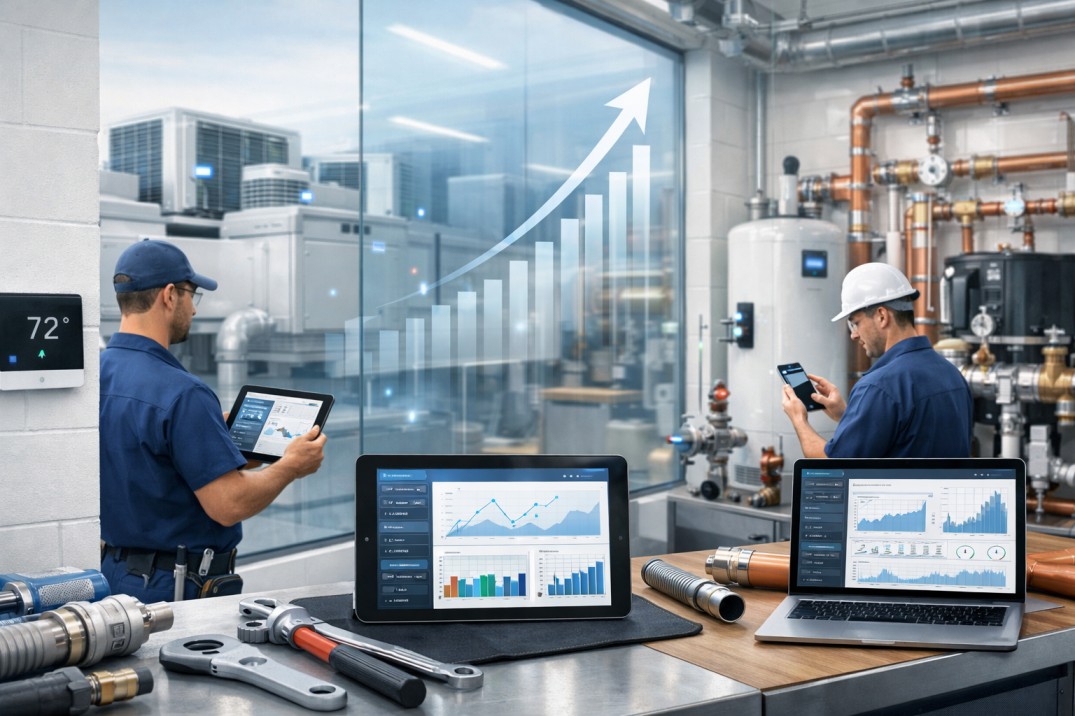
A tech-enabled HVAC business valuation is rarely “just about revenue.” In today’s market, buyers pay premiums for companies that run predictably, scale efficiently, and produce clean, defensible earnings. Technology is one of the fastest ways to prove all three—because it turns day-to-day operations into measurable systems instead of guesswork.
If you’re an owner preparing for a sale or a buyer comparing targets, it helps to understand why modern tools often translate into higher multiples. And if you want the valuation story to land with serious acquirers, it needs to connect the tech stack to real financial outcomes: stronger cash flow, lower risk, and better growth visibility.
Early in your planning, it’s worth aligning the discussion with what BlueExit sees in real transactions: buyers consistently reward HVAC companies that can show performance in dashboards, documented processes, and repeatable customer acquisition.
The valuation shift buyers are making right now
Traditional HVAC businesses can be excellent—strong demand, essential service, and recurring maintenance potential. The difference is that tech-enabled operators can often show “proof” faster and more convincingly. A tech-enabled HVAC business valuation tends to improve because buyers feel more confident about what happens after the owner steps back.
When a buyer underwrites a deal, they typically ask, “How much of this business depends on the owner’s memory and relationships?” Technology reduces that dependency. It captures information, standardizes workflows, and makes performance more transferable. Transferability is one of the biggest drivers of premium pricing.
How technology directly increases value
Better margins through operational control
Tech-enabled businesses usually see fewer preventable leaks: missed follow-ups, inefficient routing, unbilled work, and inconsistent pricing. Field service platforms, integrated dispatching, and digital invoicing can tighten the entire service cycle.
In a deal context, higher margins matter—but buyers care just as much about whether those margins are repeatable. Tech helps create repeatability.
Higher close rates and ticket values often come from faster quoting, consistent pricing, and better customer communication.
Lower rework and warranty costs can come from standardized job notes, photos, and QA checklists.
Improved labor efficiency is easier to prove when utilization and job costing are tracked consistently.
All of these support a stronger earnings profile, which supports a stronger multiple.
Cleaner financials and faster diligence
Buyers pay more when they can verify performance quickly. A tech-enabled operator that tracks job costing, service agreement metrics, and marketing attribution produces a cleaner diligence experience. And when diligence is cleaner, perceived risk drops.
In a tech-enabled HVAC business valuation, speed and clarity are value drivers. If the buyer can validate customer retention, margins by service line, technician productivity, and revenue mix without chasing spreadsheets for weeks, the deal is more likely to stay on track—and premium offers are more likely to hold.
A stronger “valuation narrative” that buyers believe
Every sale needs a story: why the business is worth what you’re asking, and why it will keep performing after closing. Technology helps make that story credible.
You can demonstrate it rather than saying, “We think we’re doing great.” Instead of “our customers love us,” you can demonstrate retention and reviews. Instead of “we’re growing,” you can present lead flow, conversion rates, and recurring revenue trends.
If you want to pressure-test how these factors translate into pricing, start with hvac business valuation and build your positioning around what buyers underwrite most heavily.
The biggest tech signals that raise multiples
Recurring revenue systems that actually run
Many HVAC businesses talk about maintenance plans. Tech-enabled companies operationalize them with automation: reminders, renewals, segment-based outreach, and churn tracking. Buyers love recurring revenue because it stabilizes cash flow and reduces dependence on new lead generation.
In valuation terms, stability supports higher multiples—especially when it’s documented and measurable.
Sales and marketing that are trackable
A business with a consistent, trackable acquisition engine is less risky. When you can tie revenue to channels, track lead response times, measure close rates, and improve performance over time, buyers see a machine—not a hustle.
This is where tech can reshape a tech-enabled HVAC business valuation: data-backed growth is easier to trust than anecdotal growth.
Service delivery that scales beyond the owner
Buyers pay premiums for teams that operate with structure. When technician performance, call handling, quality standards, and customer communications are systematized, the company becomes more transferable. Transferability is a major multiplier.
HVAC businesses If you want a practical example of how tech positioning shows up in HVAC deal discussions, see tech-enabled HVAC businesses and map those concepts directly to your operations.
Why buyers treat tech as “risk reduction”
Valuation is not only about upside. It’s also about downside protection. Buyers discount businesses when they see uncertainty: undocumented processes, inconsistent pricing, unclear job costing, and weak customer retention tracking.
Technology reduces uncertainty by making performance visible. It creates reporting rhythms, accountability, and audit trails. That’s why a tech-enabled HVAC business valuation often improves even if the business isn’t the biggest in the market—because it looks safer, cleaner, and easier to scale.
For an authoritative overview of what buyers evaluate when acquiring an existing business, the U.S. Small Business Administration’s guidance is a helpful baseline: buy an existing business or franchise (sba.gov).
FAQ
What does “tech-enabled” mean in an HVAC valuation context?
In a tech-enabled HVAC business valuation, “tech-enabled” typically means the company uses software and automation to run dispatch, quoting, invoicing, customer communication, reporting, and performance management in a repeatable way.
Do tech tools automatically increase the valuation multiple?
Not automatically. Buyers reward tech when it produces measurable outcomes: stronger margins, cleaner reporting, higher retention, and scalable operations. Tools without adoption or reporting rarely move valuation.
What tech metrics do buyers care about most?
Buyers commonly focus on recurring revenue performance, lead-to-close conversion, technician productivity, response times, job costing accuracy, and customer retention—especially when those metrics are tracked consistently over time.
How can I improve my tech-enabled HVAC business valuation before selling?
Start by standardizing workflows, tracking key metrics monthly, and ensuring financial reporting is clean and consistent. Then build a clear narrative that links operational systems to profitability and lower risk.
Next steps
If you want to increase your tech-enabled HVAC business valuation, the smartest move is to align your systems with what real buyers underwrite—and document performance in a way that holds up in diligence. If you’re preparing for a sale or want a valuation roadmap tied to operational improvements, reach out to contact us to discuss your timeline, goals, and the fastest levers to pull before going to market.